
[English version below]
Jean viene assunto come assistente da Stéphane, un fotografo ossessionato dall’antica tecnica del dagherrotipo, che utilizza la figlia Marie come modella. Innamoratosi della giovane, Jean cerca di sottrarla all’influenza del padre, ma un tragico evento rende sempre più incerto il confine tra il mondo dei vivi e quello dei morti.
Nel 2016 Kiyoshi Kurosawa gira Daguerrotype per il produttore francese Jérôme Dopffer. Non sono pochi i registi giapponesi ad aver sperimentato la produzione al di fuori dei confini nazionali, in particolare in Francia (si pensi al Koreeda di La Vérité o al recente Hamaguchi di Soudain); talvolta lo stile registico può risultarne indebolito, ma per Kurosawa, il cui cinema si muove in spazi indefiniti, oltrepassando soglie, sperimentando in luoghi differenti un nuovo stato percettivo, l’ambientazione francese permette nuove fioriture all’interno di una poetica originale.
In Daguerrotype ritroviamo le frequenti ossessioni del regista: su tutte la presenza, talora minacciosa, talora delicata e fragile, di una dimensione separata; uno spiraglio dal quale i morti osservano i vivi. Il passaggio diviene un ponte comunicativo che i defunti sono spinti ad attraversare, rivelando il labile confine tra vita e non-vita. Qualcuno torna per amore, come il protagonista di Journey to the Shore, ma anche per assaporare “ciò che non è stato” con grande rimpianto. C’è la bambina-fantasma di Séance, che sembra chiedere, attonita, responsabilità agli adulti per la sua morte tanto insensata. O c’è lo spettro vendicativo della giovane donna di Retribution, il cui dolore le scolora il viso. Spesso, nel cinema di Kurosawa, gli spiriti non hanno volto, come se le lacrime l’avessero dissolto: la sofferenza cancella i lineamenti, che colano come pittura su antichi dipinti.
In Daguerrotype la comparsa del fantasma della moglie Denise tormenta il fotografo Stéphane: si avverte, nello script, l’influenza del gotico in stile Hammer (il regista aveva inizialmente concepito il film come coproduzione inglese), ma il regista ne assimila le suggestioni. Tra le prime scene, quando il nuovo assistente Jean fa il suo ingresso nella villa, scorgiamo una vera lezione di regia: lo spazio, con un movimento di macchina, diviene sede del doppio; a destra il giovane, a sinistra una porta che si apre per una presenza sovrannaturale. Vivi e morti compresenti nella stessa inquadratura, con lo stesso “peso” segnico all’interno dell’immagine, separati dalla scala centrale e uniti da uno spostamento della macchina da presa leggero come un alito di vento.
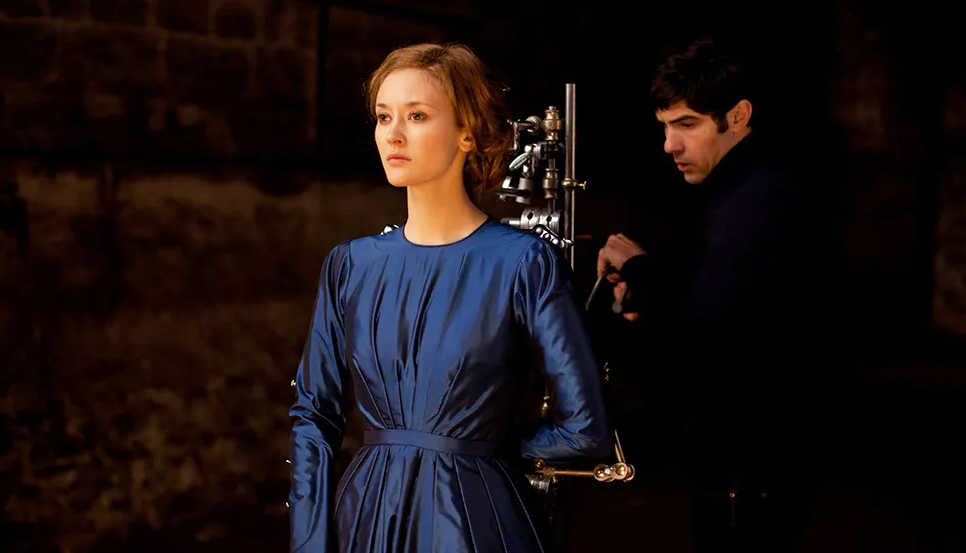
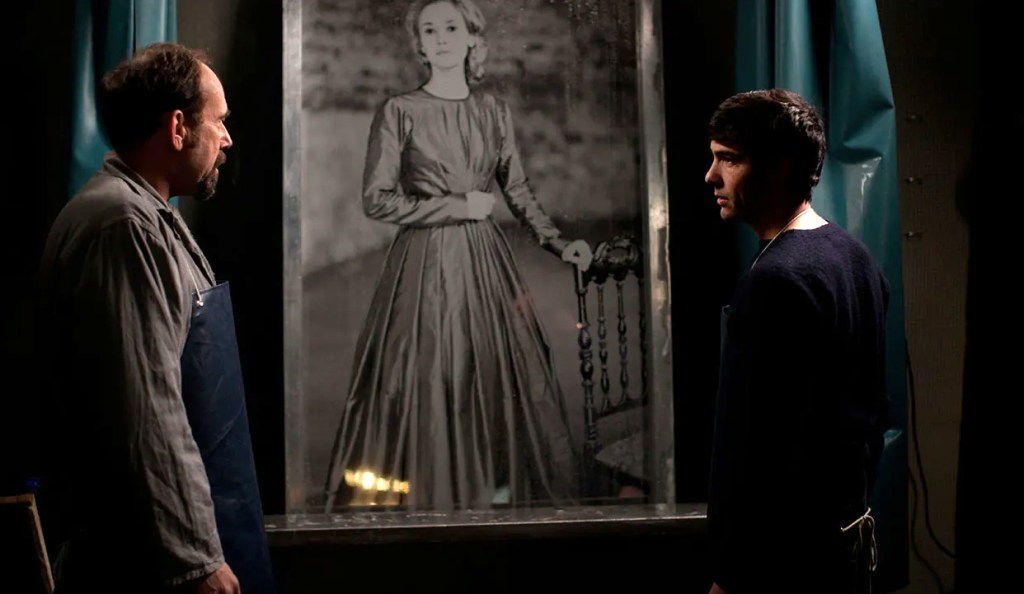
Denise è morta in circostanze incerte. Il dagherrotipo – con le sue enormi lastre, il procedimento chimico e l’apparato che costringe la modella, la figlia Marie, a posare per ore bloccata in apparecchiature sinistre – è lo strumento con cui Stéphane cerca di catturare lo spirito vivente nell’aria, e renderlo immortale. Nel suo tentativo risuona l’eco di Roland Barthes, la fotografia come medium in cui si intrecciano morte, immanenza, realtà. L’idea di una possibilità “tecnica” per rivelare il sovrannaturale era già presente in Séance, in cui il protagonista registrava il sinistro suono degli alberi agitati dal vento.
Per Kurosawa, l’oltre risiede nell’invisibile e trova nella natura un mediatore tra le dimensioni: si pensi a Charisma, con la sua foresta in cui si agitavano vibrazioni oscure. Analogamente, in Daguerrotype la presenza di una serra e il decomporsi inesorabile delle piante sono manifestazione biologica di una corruzione morale: la degenerazione dell’uomo produce frutti in putrefazione.
I protagonisti, come di frequente accade nel cinema di Kurosawa, sono moralmente ambigui, macchiati da lati inconfessabili, da imperscrutabili viltà; mentre il fantasma è mosso da incredulità o purezza.
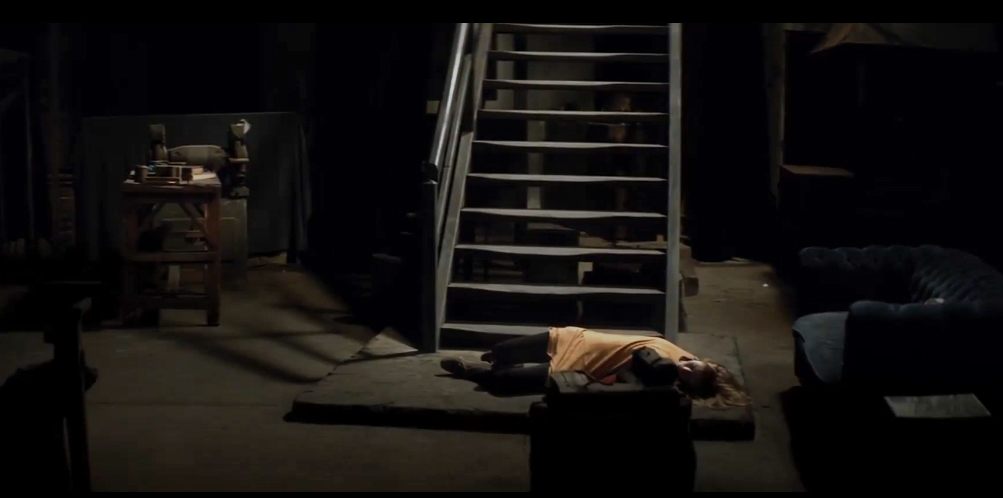
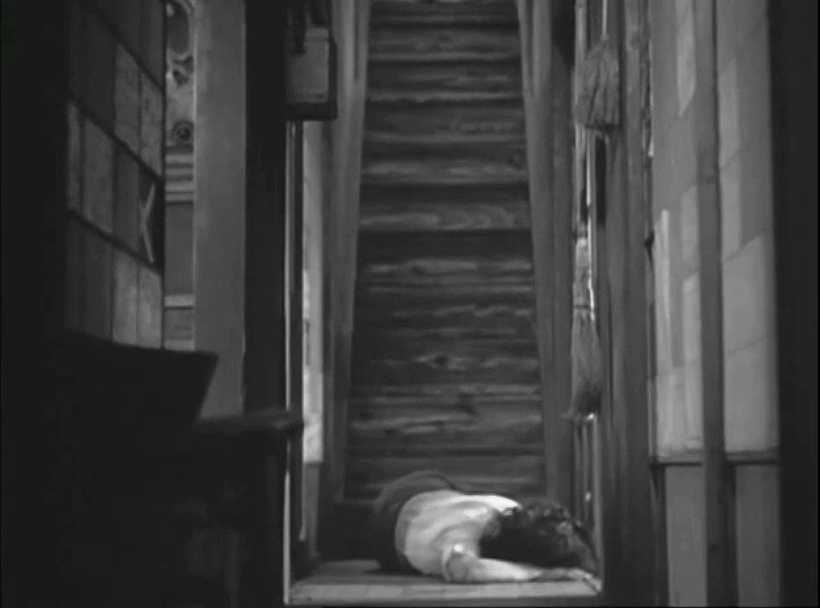
Stéphane non esita a sacrificare la libertà della figlia Marie, che per cause accidentali muore cadendo da una scala. La sequenza è particolarmente significativa, poiché mostra come i ricordi cinefili si affastellino e come il regista voglia mettere in comunicazione epoche diverse, molteplici possibilità di cinema, apparentemente inconciliabili ma ricomposte nella forma del suo sguardo. La caduta è infatti un’esplicita citazione della “scena delle scale” di Una gallina nel vento (1948) di Yasujirō Ozu, che aveva sconvolto il pubblico dell’epoca per la sua inaspettata brutalità. Come Kinuyo Tanaka, Marie cade con tutto il peso del proprio corpo, producendo tonfi sordi. L’aspetto “fisico”, gravitazionale, sonoro, rende la sequenza, girata in tutta la sua evidenza frontale, particolarmente orrorifica. Kurosawa ha sempre dichiarato di amare il film di Ozu, considerando la protagonista Tokiko come “figura già morta”, e antecedente dei suoi fantasmi morti ingiustamente.
Marie, esile e trasparente, diviene un’entità pallida e triste, trattenuta dall’amore per Jean. Il regista usa miracolosamente la presenza magnetica e “divergente” di Constance Rousseau, che conferisce a Marie un aspetto ultraterreno: l’attrice soffre di nistagmo congenito (involontari movimenti degli occhi). Lo sguardo eternamente sfuggente fa di lei un fantasma mutevole, di grande romanticismo – come sottolineano gli archi struggenti della bellissima colonna sonora hitchcockiana di Grégoire Hetzel.
Il tema del doppio, molto caro al regista, si esplicita nel ritorno di Marie, nei dialoghi in campo/controcampo con Jean, in cui Kurosawa ricorre a scavalcamenti di campo (l’anomalia di due mondi che si incontrano brevemente). Tutto si colora di perdita e nostalgia. La critica giapponese Atsuko Kawaguchi ha dato la più bella definizione di Marie, con “il suo atteggiamento riservato e i suoi occhi che tremano come la fiamma di una candela”. Con Daguerrotype, Kurosawa continua a inseguire l’intimo colloquio con la morte, la parete che momentaneamente si infrange, la lacrima che scorre.
Tutti gli articoli sono protetti da copyright: © Marcella Leonardi. Tutti i diritti riservati.
English version
Jean is hired as an assistant by Stéphane, a photographer obsessed with the early photographic technique of daguerreotypy, who uses his daughter Marie as a model. Falling in love with her, Jean tries to free her from her father’s influence, but a tragic event increasingly blurs the boundary between the worlds of the living and the dead.
In 2016, Kiyoshi Kurosawa made Daguerrotype for French producer Jérôme Dopffer. A number of Japanese directors have ventured into filmmaking beyond their national borders, particularly in France (one thinks of Koreeda’s La Vérité or Hamaguchi’s recent Soudain); sometimes their directorial style can be weakened as a result, but for Kurosawa, whose cinema moves through undefined spaces, crossing thresholds and exploring a new perceptual state in different places, the French setting allows new possibilities to blossom within an original poetics.
In Daguerrotype, we rediscover the director’s recurring obsessions: above all, the presence, sometimes threatening, sometimes delicate and fragile, of a separate dimension; an opening through which the dead observe the living. The passage becomes a bridge of communication that the dead feel compelled to cross, revealing the tenuous boundary between life and non-life. Some return out of love, like the protagonist of Journey to the Shore, but also to savour, with deep regret, “what never was”. There is the ghost of the little girl in Séance, who seems, in her bewilderment, to demand that the adults take responsibility for her senseless death. Or there is the vengeful ghost of the young woman in Retribution, whose sorrow drains the colour from her face. Often, in Kurosawa’s cinema, spirits have no faces, as though tears had dissolved them: suffering erases their features, which run like paint on old paintings.
In Daguerrotype, the apparition of his wife Denise’s ghost torments the photographer Stéphane: the influence of Hammer-style Gothic horror can be felt in the script (the director had initially conceived the film as a British co-production), but Kurosawa assimilates these influences. In one of the opening scenes, as the new assistant Jean enters the villa, we witness a veritable lesson in directing: through a camera movement, space becomes the realm of the double; on the right, the young man, on the left, a door opening to admit a supernatural presence. The living and the dead coexist within the same shot, carrying the same semiotic “weight” within the image, separated by the central staircase and united by a movement of the camera as light as a breath of wind.
Denise died under uncertain circumstances. The daguerreotype – with its enormous plates, its chemical process and the apparatus that forces the model, Stéphane’s daughter Marie, to pose for hours immobilised in sinister contraptions – is the means by which Stéphane seeks to capture the living spirit in the air and render it immortal. His endeavour echoes Roland Barthes’s conception of photography as a medium in which death, immanence and reality intertwine. The idea of a “technical” means of revealing the supernatural was already present in Séance, in which the protagonist recorded the sinister sound of trees stirred by the wind.
For Kurosawa, the beyond resides in the invisible and finds in nature a mediator between dimensions: one thinks of Charisma, with its forest alive with dark vibrations. Similarly, in Daguerrotype, the presence of a greenhouse and the inexorable decay of its plants are the biological manifestation of moral corruption: human degeneration bears rotting fruit.
The protagonists, as is often the case in Kurosawa’s cinema, are morally ambiguous, tainted by unavowable aspects of their character, by unfathomable acts of cowardice, while the ghost is driven by disbelief or purity.
Stéphane does not hesitate to sacrifice the freedom of his daughter Marie, who dies after accidentally falling down a flight of stairs. The sequence is particularly significant, as it reveals how cinephile memories accumulate and how the director seeks to bring different eras into dialogue, multiple possibilities of cinema, seemingly irreconcilable yet brought together in the form of his gaze. The fall is, in fact, an explicit quotation of the “staircase scene” from Yasujirō Ozu’s A Hen in the Wind (1948), which shocked audiences at the time with its unexpected brutality. Like Kinuyo Tanaka, Marie falls with the full weight of her body, producing dull thuds. The “physical”, gravitational and sonic qualities of the sequence, filmed with an unflinching frontal directness, make it particularly horrific. Kurosawa has consistently professed his love for Ozu’s film, regarding its protagonist, Tokiko, as an “already dead figure” and a precursor to his own ghosts of those who have died unjustly.
Marie, slender and translucent, becomes a pale, sorrowful entity, held there by her love for Jean. The director makes miraculous use of Constance Rousseau’s magnetic and “divergent” presence, which lends Marie an otherworldly appearance: the actress has congenital nystagmus (involuntary eye movements). Her perpetually elusive gaze makes her a shifting ghost imbued with romanticism – as underscored by the poignant strings of Grégoire Hetzel’s beautiful Hitchcockian score.
The theme of the double, so dear to the director, finds expression in Marie’s return, in her shot/reverse-shot exchanges with Jean, in which Kurosawa breaks the 180-degree rule (the anomaly of two worlds briefly meeting). Everything becomes tinged with loss and nostalgia. The Japanese critic Atsuko Kawaguchi has offered the most beautiful description of Marie, with “her reserved demeanour and her eyes that tremble like the flame of a candle”. With Daguerrotype, Kurosawa continues to pursue an intimate dialogue with death, the wall that momentarily shatters, the tear that falls.
All articles are protected by copyright: © Marcella Leonardi. All rights reserved.






Rispondi