

[Please scroll down for the english version]
Jin, un mediocre impiegato, passa le notti a correre per strada con lo skateboard. Un giorno incontra lo skater radicale Ikeda e inizia a vivere in modo ancor più estremo la sua passione, andando incontro a problemi con i cittadini, risse, fughe, fino allo scontro finale con due vendicatori.
Jin è uno di quei salariati di cui è costellato il cinema giapponese a partire dal muto (Tokyo chorus, Yasujirō Ozu, 1931, o Koshiben ganbare, Mikio Naruse, 1931, per citarne alcuni). La figura del sararīman, completo scuro e camicia bianca, vessato da un capo dispotico e sottoposto ad ogni sorta di abuso (mobbing, sfruttamento, umiliazione) nel 1989 portò anche un regista anarchico e incendiario come Shin’ya Tsukamoto a inventare Tetsuo, uomo-macchina sottoprodotto dell’alienazione urbana (vera visione d’inferno in stop motion per le strade di Tokyo). Ma non dimentichiamo anche le parole di Chishū Ryū in Early Spring (Sōshun, 1956, Yasujirō Ozu): “Questo è il destino degli impiegati… A volte odio il mio lavoro. Tutti oggi sono insoddisfatti”
Il sararīman di Wings of the Abyss (2021, Yuki Kobayashi) è la versione contemporanea dell’impiegato schiacciato dal sistema: il regista ci mostra sin dall’incipit la vita avvilente di Jin, costretto a grottesche riunioni di lavoro e a un abuso quotidiano che lo rende opaco persino a se stesso. Kobayashi non fornisce alcun indizio riguardo alla psicologia di Jin, proprio perché egli agisce ma non pensa, mosso da un grumo di istintività e da una condizione di costante alienazione. Alla miseria delle ore d’ufficio risponde con un unico, totalizzante impulso: attraversare la città sullo skateboard, saltando su gradini e panchine, tra marciapiedi affollati e carreggiate.
Nel momento in cui Jin sale sullo skateboard, la regia si svincola da coordinate convenzionali e reinventa lo spazio in forme liberatorie, all’insegna della velocità, dell’impermanenza, di luci e colori ammirati nella loro valenza astratta. Lo skateboard diviene strumento politico in antitesi a una società rigidamente performante.
Kobayashi si serve di un editing particolarmente personale, denso di tagli e jump-cuts anti-narrativi, volto a riprodurre l’intensità dell’hic et nunc: a Jin interessa solamente il “sentimento presente” della corsa sullo skate; tutto ciò che precede e segue lo skateboarding non è, ai suoi occhi, che una sequenza di raccordi.
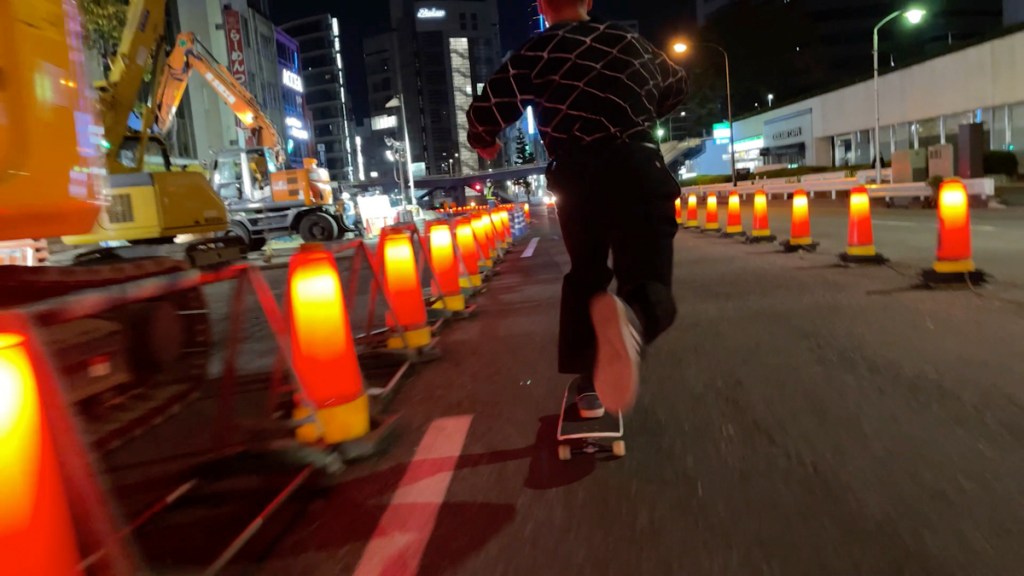

L’incontro con lo skater Ikeda e il suo gruppo di sbandati intensifica il desiderio di libertà e sradica Jin ulteriormente dai codici sociali. La banda vive per soddisfare la propria pulsione – lo skateboarding sempre più estremo – e considera gli spazi urbani come un enorme skate-park da dominare (e danneggiare) senza alcuno scrupolo etico. Uno degli aspetti più interessanti del film è lo sguardo entomologico di Kobayashi, che trattiene ogni forma di giudizio e asciuga l’immagine da sottotesti morali: al regista preme riprodurre la pura ebbrezza della corsa – servendosi di sinuosi movimenti di macchina, accelerazioni, composizioni astratte e dinamiche – così come viene vissuta da Jin e dal resto del gruppo.
Questa vena “documentaria” (che molto ha in comune con il Gus Van Sant di Elephant, 2003) viene spezzata dall’arrivo, nell’ultima parte del film, dei “vendicatori in abiti bianchi”, due personaggi che imprimono una nuova direzione alla vicenda. La coppia – che si muove in sincrono e attacca con leggerezza coreografica – porta alle estreme conseguenze il clima di violenza e controllo emersi finora in segnali sporadici. Gelidi e determinati come in un thriller alla Haneke, i “giustizieri” si accaniscono brutalmente contro gli skaters per punirli del loro sprezzo delle regole. Kobayashi gestisce con rigore l’esplosione della furia e del sangue, incanalando gli scontri in sequenze rapide, di grande suggestione grafica e dal forte carico sensoriale.
Autoprodotto dal regista, Wings of the Abyss è chiaramente un lavoro d’amore, che denuncia – a partire da una prospettiva inedita – tanto la violenza “antropologica” connaturata alla società giapponese, quanto l’illusione dell’anarchia. Ma è anche un’opera densa di cinema (da Lynch a Bergman, soprattutto nella sequenza del “passaggio macabro” all’aldilà), che ripercorre il passato per dare nuova forma all’immaginario presente. Particolarmente suggestiva la citazione di Texas Chainsaw Massacre (1974), con un Jin-Leatherface che brandisce uno skate quale arma di libertà.


English Version
Jin, a mediocre office worker, spends his nights racing through the streets on his skateboard. One day he meets the radical skater Ikeda and begins to pursue his passion in an even more extreme way, running into trouble with local residents, brawls, chases, and eventually a final showdown with two vigilantes.
Jin belongs to that long lineage of salaried workers that populate Japanese cinema starting from the silent era (Tokyo Chorus, 1931, by Yasujirō Ozu, or Koshiben Ganbare, 1931, by Mikio Naruse, to name a few). The figure of the sararīman—dark suit, white shirt—tormented by a despotic boss and subjected to every kind of abuse (mobbing, exploitation, humiliation) inspired even an anarchic and incendiary director like Shin’ya Tsukamoto to create Tetsuo in 1989, a man-machine born from urban alienation (a true stop-motion vision of hell through the streets of Tokyo). But we should also recall Chishū Ryū’s words in Early Spring (Sōshun, 1956, Yasujirō Ozu): “This is the fate of office workers… Sometimes I hate my job. Everyone today is dissatisfied.”
The sararīman in Wings of the Abyss (2021, Yuki Kobayashi) is the contemporary incarnation of the employee crushed by the system: from the very opening, the director shows us Jin’s demeaning life, made up of grotesque work meetings and daily abuse that renders him opaque even to himself. Kobayashi offers no clue regarding Jin’s psychology, precisely because Jin acts without thinking, driven by a knot of instinct and a condition of constant alienation. To the misery of office hours he responds with a single, all-consuming impulse: crossing the city on his skateboard, leaping over steps and benches, through crowded sidewalks and traffic lanes.
The moment Jin steps on his skateboard, the direction frees itself from conventional coordinates and reinvents space in liberating forms, guided by speed, impermanence, and light. The skateboard becomes a political instrument in opposition to a rigidly performance-driven society. Kobayashi employs a highly personal editing style, dense with cuts and anti-narrative jump cuts, aiming to reproduce the intensity of the hic et nunc: Jin cares only for the “present feeling” of the ride; everything that precedes and follows skateboarding is, in his eyes, merely connective tissue.
Jin’s encounter with the skater Ikeda and his band of drifters intensifies his desire for freedom and uproots him even further from social codes. The group lives to sate its own impulse—ever more extreme skateboarding—and regards urban spaces as a vast skate park to dominate (and damage) without any ethical restraint. One of the film’s most interesting aspects is Kobayashi’s entomological gaze, which excludes any form of judgment and pares the image down to remove moral subtext: the director is intent on capturing the pure exhilaration of motion—as experienced by Jin and the rest of the group—through sinuous camera movements, accelerations, and abstract, dynamic compositions.
This “documentary vein” (which has much in common with Gus Van Sant’s Elephant, 2003) is disrupted in the film’s final section by the arrival of the “vigilantes in white,” two characters who give the narrative a new direction. The pair—moving in sync and striking with choreographic lightness—push to the limit the atmosphere of violence and control that had appeared only in sporadic signals until this point. Cold and determined, like figures from a Haneke-style thriller, these “avengers” brutally attack the skaters to punish them for their disregard of the rules. Kobayashi stages the explosion of fury and blood with precision, channeling the clashes into rapid sequences of great graphic power and sensory impact.
Self-produced by the director, Wings of the Abyss is clearly a labor of love that denounces—through an unusual perspective—both the “anthropological” violence inherent in Japanese society and the illusion of anarchy. But it is also a film dense with cinematic echoes (from Lynch to Bergman, especially in the “macabre passage” to the afterlife), revisiting the past in order to reshape contemporary imagery. Particularly striking is the quotation from The Texas Chainsaw Massacre (1974), with a Jin-Leatherface brandishing a skateboard as a weapon of freedom.













 Nubi Fluttuanti
Lascia un commento