

[English version below]
Un rozzo montanaro uccide le sue sei mogli per assecondare una donna affascinante che ha catturato. Man mano che il tempo passa, l’uomo si spinge a compiere crimini sempre più efferati per compiacere la sua nuova moglie, creatura sadica e necrofila.
Scritto nel 1947, all’indomani della Seconda guerra mondiale, in un paese prostrato e ridotto a sentimenti primordiali e violenti (scrisse Ozu nel 1951: “Mi dispiace, non riesco più a sentire lo stesso affetto (…). In passato quelle persone non erano senza cuore così come sono oggi”), il racconto di Sakaguchi Ango mette in scena una vicenda agghiacciante, in cui i confini tra sogno e incubo, bellezza e orrore sono labili e sfuggenti come il vento gelido che spira tra i fiori di ciliegio. Petali di sovrumana bellezza si moltiplicano sugli alberi e creano un sovraccarico sensoriale – di colori, profumi, di un delicato stormire tra i rami – che diviene per l’essere umano qualcosa di minaccioso e inspiegabile. Sakaguchi animava le sue foreste di uno spirito malvagio quanto magnifico e vago, simile a una presenza femminile di inusitata crudeltà e leggiadria, capace di liberare un desiderio pulsionale in chiunque la ammirasse. Nel racconto, il rude montanaro protagonista resta schiavo di un incanto che lo trascina nel più profondo abominio: la donna da lui catturata e presa in moglie è seducente come ciliegi in fiore, ma dominata dalla follia. Per lei, il montanaro ucciderà le sue mogli, taglierà teste, si piegherà alla vanità della donna e alle sue voglie perverse.
Shinoda, studioso e appassionato di letteratura, profondamente interessato a trasporre forme e strutture letterarie in immagini – alla ricerca di un nuovo emerso dalle ceneri dei linguaggi tradizionali – si avvicina al racconto di Sakaguchi con rispetto, riproducendone la sequenza di eventi così come i dialoghi e le perturbanti atmosfere, frutto della psiche alterata dei protagonisti. Ma là dove Sakaguchi si prodigava in descrizioni minuziose, facendo della parola uno strumento affilato e innocente, usato nella sua nuda evidenza per mettere in scena l’orrore e la malattia insiti nell’esistenza umana, Shinoda consegna all’immagine il carico di significanza delle dense pagine dello scrittore.
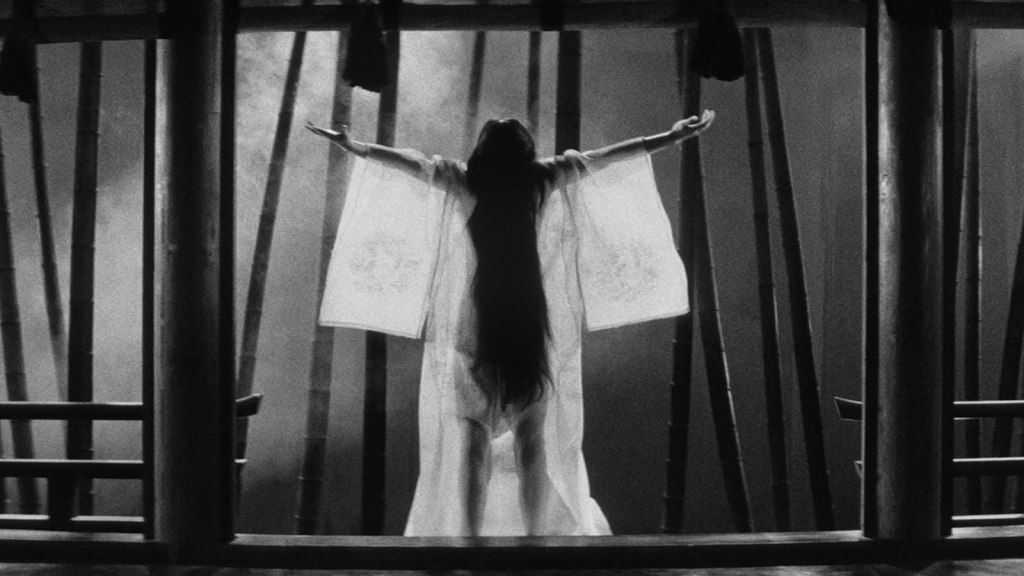
Per questo motivo le sue inquadrature sono profonde e stratificate: all’interno dell’immagine lo spettatore può “muoversi” tra molteplici informazioni, soffermarsi su oggetti e indizi in avampiano, lasciar scorrere lo sguardo ai margini (spazio prediletto da Shinoda per collocarvi la presenza umana), fino a cogliere le microstorie sullo sfondo (un gatto, un personaggio, una finestra/palcoscenico sul mondo).
La bellezza della visione di Shinoda risiede in questo atto di trasformazione della pagina in una immagine/microcosmo di qualità tridimensionale. Emerge la sua ammirazione per Orson Welles, che ne influenza la scomposizione dell’inquadratura in una pluriformità esplorata da una regia osservatrice e testimone della degenerazione dell’essere umano.
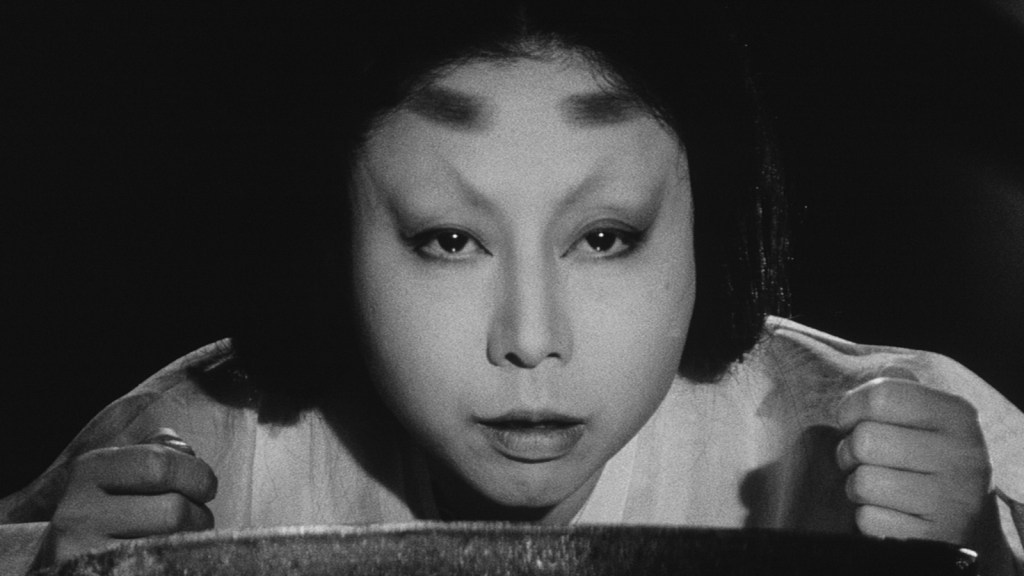
Occhio voyeuristico, analitico, non di rado morboso, la macchina da presa “emotiva e pensante” di Shinoda si sofferma sul corpo della donna (la musa Shima Iwashita), ne ammira con voluttà la pelle diafana e le labbra carnose. In una scena ne spia i giochi erotici perversi con una passione feticista che è la medesima del protagonista: Shinoda indugia sui seni, sulla bocca, sui piedi pallidi e delicati capaci di scatenare l’irrazionale bramosia del marito. La densa atmosfera erotica che satura le scene è indissolubilmente legata a un sentimento di repulsione e disprezzo e l’inquietudine è accentuata dalle note dissonanti del grande compositore Tōru Takemitsu, che sollecita un continuo ritorno del rimosso sovvertendo canoni tradizionali e melodie, a favore di composizioni disarmoniche e sperimentali.
“Mondo di sofferenza, eppure i ciliegi sono in fiore”: dalle immagini di Shinoda spira la stessa triste e crudele poesia dei versi di Kobayashi Issa (小林一茶, 1763–1828), l’orrore nei confronti di una bellezza corrotta dal male e dagli istinti. Si avverte una riflessione altra, un pensiero per un Paese in cui un’estetica squisita, di impalpabile grazia, convive con una storia percorsa dalla violenza. La foresta di ciliegi in fiore osserva il male dell’uomo e lo investe del suo potere e del suo monito: la dissoluzione, con i corpi dei due amanti fagocitati in un nulla che diviene petalo soffiato dal vento.
Così come Shinoda, anche Kiyoshi Kurosawa in Charisma o Ryūsuke Hamaguchi in Il male non esiste ci raccontano di una natura aliena e gelida, dotata di un proprio “istinto” e sprezzante delle macabre miserie umane.


English Version
A rough mountain dweller kills his six wives to satisfy a captivating woman he has abducted. As time passes, he commits ever more heinous crimes to please his new wife, a sadistic, necrophilic creature.
Written in 1947, in the aftermath of the Second World War, in a country brought to its knees and reduced to primal, violent feelings—as Ozu wrote in 1951, “I’m sorry, I can no longer feel the same affection (…). In the past, those people were not as heartless as they are today”—Ango Sakaguchi’s story unfolds a chilling tale in which the boundaries between dream and nightmare, beauty and horror are as elusive and shifting as the icy wind blowing through the cherry blossoms. Petals of superhuman beauty proliferate on the trees, creating a sensory overload—of colours, scents, a delicate rustling among the branches—that becomes something threatening and inexplicable to human beings. Sakaguchi imbued his forests with a spirit at once malevolent, magnificent and elusive, akin to a female presence of extraordinary cruelty and grace, capable of unleashing instinctual desire in anyone who gazed upon her. In the story, the rough mountain dweller falls captive to an enchantment that draws him into the depths of abomination: the woman he has abducted and taken as his wife is as seductive as the cherry trees in bloom, yet ruled by madness. For her, he will kill his wives, sever heads, submit to her vanity and her perverse desires.
Shinoda, a devoted student of literature, deeply interested in translating literary forms and structures into images—in search of something new emerging from the ashes of traditional modes of expression—approaches Sakaguchi’s story with respect, preserving its sequence of events, its dialogue and the unsettling atmospheres born of its protagonists’ disturbed psyches. Yet where Sakaguchi lavished attention on minute descriptions, making language a sharp and innocent instrument, used in its naked directness to stage the horror and sickness inherent in human existence, Shinoda entrusts the image with the weight of meaning carried by the writer’s dense pages.
His shots are therefore deep and layered: within the image, viewers can “move” among multiple strands of information, linger over objects and clues in the foreground, let their gaze wander towards the edges—Shinoda’s preferred space for the human figure—and finally discern the miniature stories unfolding in the background: a cat, a character, a window opening like a stage onto the world.
The beauty of Shinoda’s vision lies in this transformation of the page into an image that is itself a microcosm, endowed with a three-dimensional quality. His admiration for Orson Welles emerges in the way he articulates the frame into multiple planes and forms, explored by a directorial gaze that observes and bears witness to human degeneration.
A voyeuristic, analytical and often morbid eye, Shinoda’s “feeling and thinking” camera lingers over the woman’s body—played by his muse, Shima Iwashita—voluptuously admiring her translucent skin and full lips. In one scene, it spies on her perverse erotic games with a fetishistic passion identical to the protagonist’s: Shinoda dwells on her breasts, her mouth, the pale, delicate feet capable of arousing her husband’s irrational lust. The dense erotic atmosphere saturating these scenes is inextricably bound to feelings of revulsion and contempt. The unease is heightened by the dissonant notes of the great composer Tōru Takemitsu, who elicits a continual return of the repressed, subverting traditional conventions and melodies in favour of dissonant, experimental compositions.
“A world of suffering, and yet the cherry trees are in bloom.” The same sad, cruel poetry that inhabits the verse of Kobayashi Issa (小林一茶, 1763–1828) breathes through Shinoda’s images: a horror at beauty corrupted by evil and instinct. Another line of reflection makes itself felt, a thought for a country whose culture rests upon an exquisite aesthetic of intangible grace, yet harbours a destiny of violence rooted in human nature. The forest of blossoming cherry trees watches humanity’s evil and brings its power and warning to bear upon it: dissolution, as the lovers’ bodies are swallowed into a nothingness that becomes a petal blown by the wind.
Like Shinoda, Kiyoshi Kurosawa in Charisma and Ryūsuke Hamaguchi in Evil Does Not Exist also portray an alien, cold nature, endowed with an “instinct” of its own and contemptuous of humanity’s macabre miseries.




Rispondi