
[English version below]
La trama ruota attorno al contrasto tra due donne: la moglie del protagonista, Kinuyo, vestita con il tradizionale kimono, e la moga, la ‘ragazza moderna’ occidentalizzata e provocante. Il commediografo Shibano cerca invano di trovare la concentrazione necessaria per scrivere: ai rumori della vita domestica si aggiunge la musica proveniente dalla casa accanto. L’incontro con la vicina, un’esuberante cantante di jazz, gli offrirà una nuova ispirazione, suscitando nella moglie sentimenti di gelosia.
Se nel cinema internazionale il sonoro aveva già fatto il suo debutto, culminato nel film americano Il cantante di jazz (Alan Crosland, 1927), nel 1930 il Giappone non aveva ancora messo a punto una tecnologia pienamente soddisfacente. La Nikkatsu aveva già realizzato film parzialmente sonori, grazie all’utilizzo di dischi per alcune scene. Ma è solo nel 1931 che Kido Shiro, sollecitato dalle ricerche dei fratelli Tsuchihashi, decide di produrre il primo film interamente sonorizzato con il sistema “Shochiku Phone in stile Tsuchihashi”.
La scelta ricade su Madamu to nyōbō (The neighbor’s wife and mine), diretto da Heinosuke Gosho, interpretato dalla star in ascesa Kinuyo Tanaka e girato negli studi della Shochiku Kamata, dove da alcuni anni Kido Shiro produceva popolari shomingeki – drammi o commedie sulla vita della gente comune – con una particolare attenzione ai personaggi femminili.
The neighbor’s wife and mine è la quintessenza dello stile Shochiku sotto la direzione di Kido, che rappresentò una vera “età dell’oro” per il cinema giapponese. Si tratta di una commedia sociale in cui confluiscono le contraddizioni del periodo, quella particolare compresenza di occidentalizzazione e di un conservatorismo di matrice nazionalista che, come ben nota la studiosa Wada-Marciano (1), non sono fenomeni contrapposti ma concorrono entrambi, attraverso valori differenti e talvolta conflittuali, alla costruzione immaginaria di un’identità giapponese. Tradizione e modernità qui assumono i volti femminili di Kinuyo Tanaka, la moglie in kimono, e Satoko Date, la scatenata moga (modern girl) in abiti occidentali: ma come vedremo, le differenze tra le due donne sono molto più labili di quanto si possa immaginare.
Del resto, in Dragnet Girl di Yasujirō Ozu, di due anni successivo, presente e passato finiranno col corteggiarsi reciprocamente in senso quasi letterale – si pensi al bacio allusivo tra Tokiko, la spregiudicata donna del gangster, e Kazuko, l’innocente ragazza all’antica. The neighbor’s wife and mine diventa quindi interessante non solo per lo stile o l’avanguardia tecnica, ma come ritratto di un Paese in cui si agitano tensioni opposte: desiderio di libertà, attrazione per il nuovo imperativo della velocità e, contemporaneamente, attaccamento ai valori tradizionali. In un Giappone provato dalla crisi, l’immaginario volge alle nuove seduzioni occidentali, ma il nazionalismo cresce insieme al bisogno di stabilità.
La stessa regia di Gosho è ricca di contrasti: l’incipit è condotto con una macchina da presa mobilissima, tipica ancora di certo cinema muto, con parecchi tagli di montaggio e soluzioni visive squisite. Umoristicamente, non appena il sonoro fa il suo ingresso, la frase pronunciata da un personaggio è “puoi stare zitto, per favore?”
Gosho si diverte moltissimo a lasciar irrompere i suoni sullo schermo: fischiettii, urla, tonfi, il clacson del camion (guidato da Takeshi Sakamoto), il frinire delle cicale. Il regista fa eco alla colonna sonora con uno stile vivace e ritmato: jump cuts, una rapida alternanza di piani ravvicinati e campi lunghi, una predilezione per le gag fisiche (al posto di una torta in faccia però abbiamo una tavolozza di pittore).
Il passaggio dal muto al sonoro diventa, nella trama, una lotta tra la quieta concentrazione – il protagonista Shibano reclama il silenzio per scrivere un testo teatrale – e la tensione a una nuova ispirazione: rumorosa, musicale, fresca come l’esuberante vicina.
L’apparizione di una giovanissima Kinuyo Tanaka ci trasmette subito le contraddizioni e l’agitarsi del suo personaggio di “moglie tradizionale”. I primi piani mettono in evidenza, mediante la mimica del volto, il carattere e il disappunto di Kinuyo, stanca di questo marito fannullone. Non è la prima volta che a Tanaka vengono affidati ruoli di donne alle prese con uomini intellettuali e pigri (si pensi a Mi sono laureato, ma…, 1929, Yasujirō Ozu), proprio perché dall’attrice sprigiona un nuovo spirito volitivo e indipendente, pur all’interno di un’estetica “classica”. Kinuyo veste in kimono ed è “formalmente” remissiva, ma in realtà redarguisce il marito, lo critica apertamente e manifesta il proprio scontento.
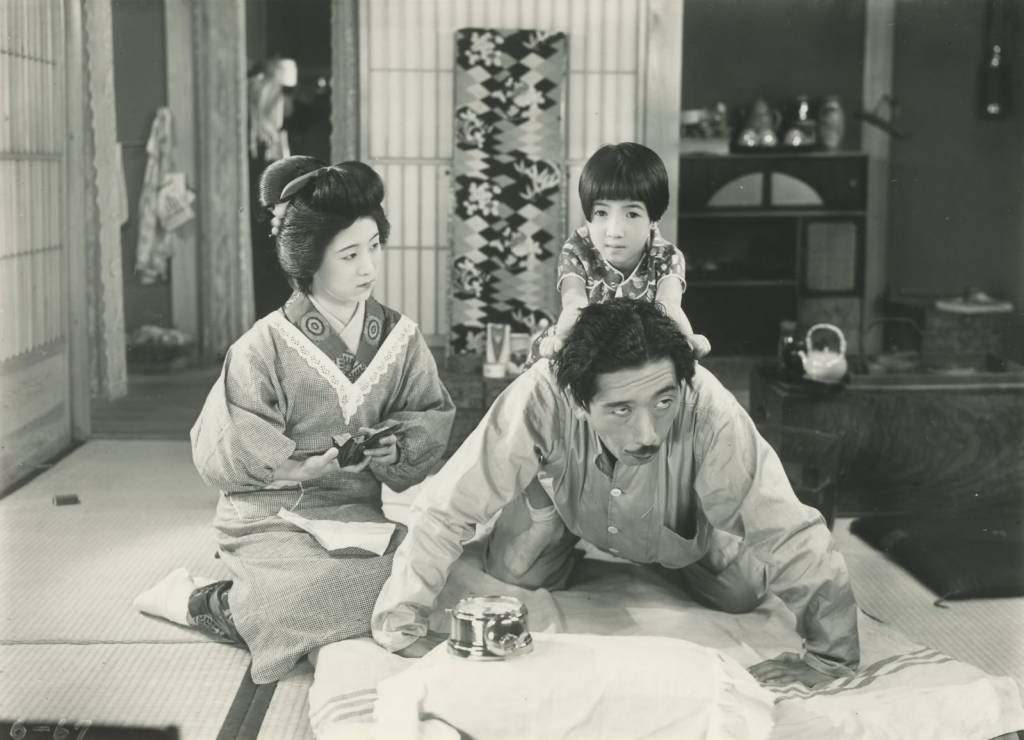
La casa degli Shibano è piccola e claustrofobica e Gosho l’anima con l’utilizzo della profondità di campo, in cui ciascun membro della famiglia trova una collocazione: uno spazio stratificato (anche gerarchicamente) in cui si susseguono buffi litigi e recriminazioni.
Quando Shibano si decide, finalmente, a mettersi al lavoro, assieme ai tentativi di scrittura iniziano anche i rumori: i pianti dei figli, i miagolii di gatti randagi, il campanello di casa. I “disturbi sonori” si presentano in sequenza e anche la reazione dello scrittore è seriale: Gosho sfrutta con abilità il meccanismo del comico imperniato sulla ripetizione/variazione. Ad ogni rumore, Shibano accartoccia il foglio su cui sta scrivendo e lo getta, stizzito, nel cestino; finché dalla finestra non arriva una trascinante ondata di musica occidentale. La moglie lo sprona: “È jazz. Scrivi a ritmo!”
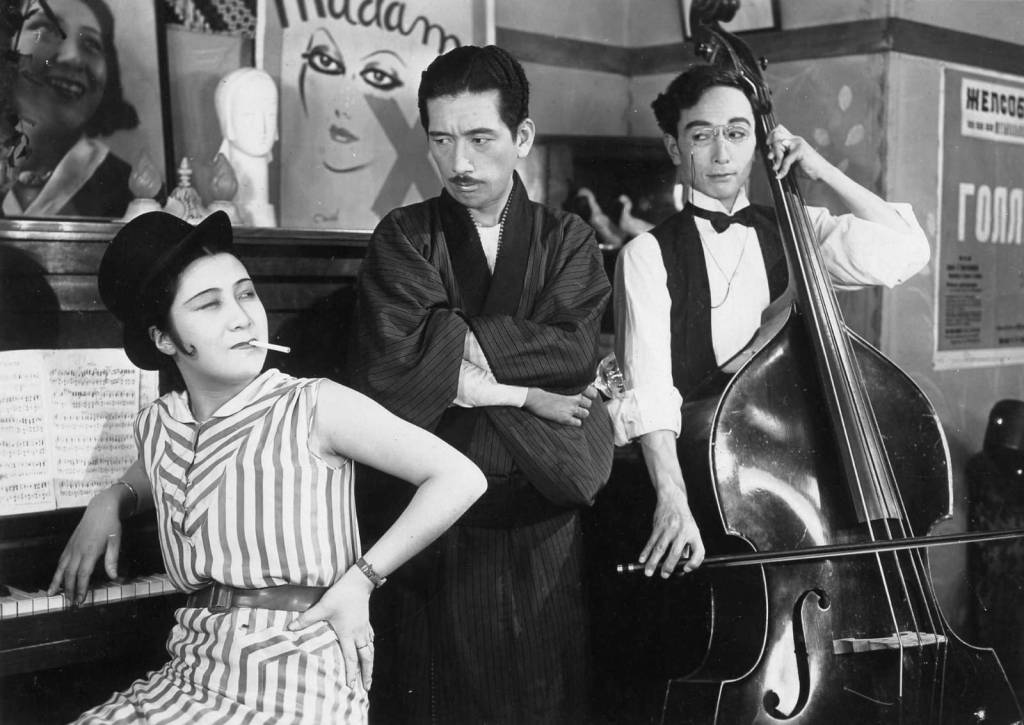
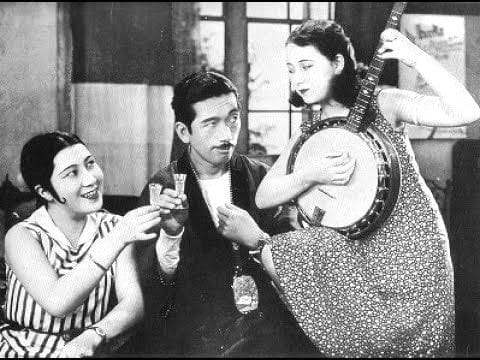
Con l’entrata in scena del jazz, il film cambia veramente ritmo. Shibano si reca nella casa accanto e si trova davanti la vicina, abbigliata all’occidentale, intenta a cantare canzoni jazz come The Age of Speed, circondata dalla sua band. La sequenza è bellissima perché estremamente composita: c’è chi balla in primo piano, chi suona sullo sfondo; i personaggi affollano l’inquadratura e la vivacizzano con entrate e uscite; la regia alterna stacchi ravvicinati a riprese più lunghe e complesse. Alle pareti, poster di ogni genere enfatizzano l’idea della modernità che avanza. Caos, improvvisazione e internazionalità dominano lo schermo. Shibano ne viene conquistato e torna a casa cantando “Speed, Speed, Speed”.
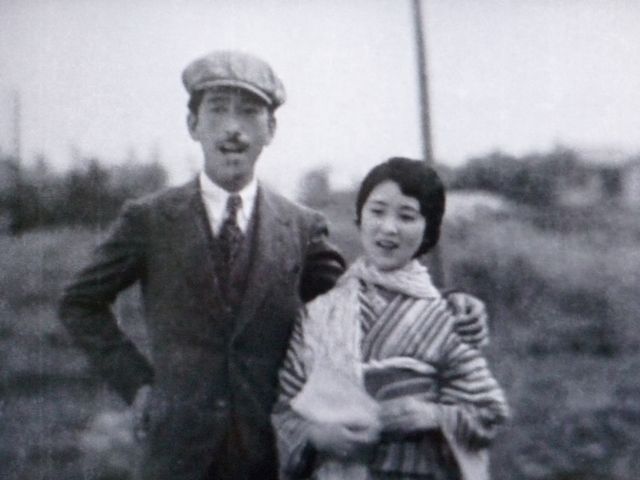
Ma il film acquista un fascino particolare anche grazie alle doti di Tanaka, che sa essere al tempo stesso interprete comica, drammatica, seducente o innocente. La sua Kinuyo, ingelosita dalla vicina ma anche attratta dal suo stile di vita, esprime un ribollire di sentimenti contrastanti. Il regista le dedica bellissimi piani ravvicinati, indugia sui dettagli del suo abbigliamento e della sua acconciatura – estremamente tradizionali – mentre attraverso dissolvenze mostra le emozioni che trascorrono sul suo viso. Per sua stessa ammissione, Kinuyo trova erotica la vicina, e sfoga nel movimento ritmico della rumorosa macchina da cucire tutta la sua rabbia. “Voglio anch’io un vestito come il suo!” chiede al marito; la modernità entra nella sua vita attraverso la gelosia, l’invidia e il desiderio. Il film si chiude con una “musica nuova” per entrambi i coniugi, che ritrovano l’equilibrio cantando insieme una canzone jazz, mentre Kinuyo sfoggia una nuova acconciatura e un pacchetto (forse un abito all’occidentale?) sottobraccio.
Tutti gli articoli sono protetti da copyright: © Marcella Leonardi. Tutti i diritti riservati.
- Mitsuyo Wada-Marciano, “The Creation of Modern Space”, in Nippon Modern: Japanese Cinema of the 1920s and 1930s, University of Hawai‘i Press, 2008, pp. 15–42
English version
The plot revolves around the contrast between two women: the protagonist’s wife, Kinuyo, dressed in a traditional kimono, and the moga, the provocative, Westernised ‘modern girl’. Playwright Shibano struggles in vain to find the concentration he needs to write: the sounds of domestic life are compounded by the music coming from next door. An encounter with his neighbour, a vivacious jazz singer, will provide him with fresh inspiration, stirring feelings of jealousy in his wife.
While the introduction of sound in international cinema had already reached a milestone with the American film The Jazz Singer (Alan Crosland, 1927), by 1930 Japan had yet to develop a fully satisfactory sound technology. Nikkatsu had already produced films featuring sound in certain scenes through the use of discs. But it was not until 1931 that Kido Shiro, encouraged by the research of the Tsuchihashi brothers, decided to produce the first fully sound film using the “Tsuchihashi-style Shochiku Phone” system.
The film chosen was Madamu to nyōbō (The Neighbor’s Wife and Mine), directed by Heinosuke Gosho, starring the rising star Kinuyo Tanaka and shot at Shochiku’s Kamata studios, where Kido Shiro had been producing popular shomingeki – dramas or comedies about the lives of ordinary people – for several years, with particular attention to female characters.
The Neighbor’s Wife and Mine is the quintessence of the Shochiku style under Kido’s leadership, a period that represented a veritable “golden age” for Japanese cinema. It is a social comedy in which the contradictions of the period converge, reflecting that peculiar coexistence of Westernisation and a form of conservatism rooted in nationalism which, as scholar Wada-Marciano aptly observes (1), are not opposing phenomena but both contribute, through differing and sometimes conflicting values, to the imaginary construction of a Japanese identity. Tradition and modernity here take on the female faces of Kinuyo Tanaka, the kimono-clad wife, and Satoko Date, the uninhibited moga (modern girl) in Western attire: yet, as we shall see, the distinctions between the two women are far less clear-cut than one might imagine.
Indeed, in Yasujirō Ozu’s Dragnet Girl, made two years later, present and past will end up courting each other in an almost literal sense – consider the suggestive kiss between Tokiko, the audacious gangster’s girlfriend, and Kazuko, the innocent, old-fashioned girl. The Neighbor’s Wife and Mine is thus interesting not only for its style or technical innovation, but also as a portrait of a country in which opposing tensions are at play: a desire for freedom, a fascination with the new imperative of speed and, at the same time, an attachment to traditional values. In a Japan battered by economic crisis, the collective imagination turns towards the new allure of the West, while nationalism grows alongside the need for stability.
Gosho’s direction itself is rich in contrasts: the opening sequence is filmed with a highly mobile camera, still typical of certain silent films, with numerous cuts and exquisite visual solutions. Amusingly, as soon as sound makes its entrance, one of the characters utters the words: “Will you please be quiet?”
Gosho takes great delight in letting sounds burst onto the screen: whistles, shouts, thuds, the horn of a truck (driven by Takeshi Sakamoto), the chirping of cicadas. The director echoes the soundtrack through a lively, rhythmic style: jump cuts, rapid alternation between close shots and long shots, and a penchant for physical gags (although instead of a pie in the face, we have a painter’s palette).
The transition from silent to sound cinema becomes, within the narrative, a struggle between quiet concentration – the protagonist, Shibano, demands silence to write his play – and a yearning for a new kind of inspiration: noisy, musical, and as fresh as the exuberant woman next door.
The appearance of a very young Kinuyo Tanaka immediately conveys the contradictions and inner restlessness of her character as a “traditional wife”. Through her facial expressions, the close-ups bring out Kinuyo’s temperament and exasperation with her idle husband. It is not the first time that Tanaka has been cast as a woman dealing with an intellectual but indolent man (one need only think of I Graduated, But…, 1929, Yasujirō Ozu), precisely because the actress radiates a new spirit of determination and independence, even within a “classical” aesthetic. Kinuyo wears a kimono and is “outwardly” submissive, yet in reality she scolds her husband, openly criticises him and expresses her dissatisfaction.
The Shibanos’ home is small and claustrophobic, and Gosho brings it to life through his use of depth of field, allowing each member of the family to occupy a distinct place within the frame: a layered space, hierarchically as well as visually, in which amusing quarrels and recriminations unfold.
When Shibano finally decides to get down to work, his attempts at writing are accompanied by a succession of noises: the children crying, stray cats meowing, the doorbell ringing. These “sound disturbances” occur in sequence, and the writer’s reaction follows a recurring pattern: Gosho skilfully exploits the comic mechanism of repetition and variation. At every noise, Shibano crumples the sheet of paper he is writing on and irritably throws it into the wastepaper basket, until a rousing wave of Western music comes pouring through the window. His wife encourages him: “It’s jazz. Write to the beat!”
As jazz makes its entrance, the film genuinely changes its rhythm. Shibano goes over to the house next door, where he finds his neighbour, dressed in Western clothes, singing jazz songs such as The Age of Speed, surrounded by her band. The sequence is particularly beautiful for the complexity of its composition: some characters dance in the foreground while others play music in the background; they crowd the frame, enlivening it with their entrances and exits; the direction alternates cuts to closer shots with longer, more elaborate takes. Posters of all kinds adorn the walls, emphasising the sense of advancing modernity. Chaos, improvisation and cosmopolitanism dominate the screen. Shibano is captivated and returns home singing “Speed, Speed, Speed”.
But the film also owes much of its charm to Tanaka’s gifts as an actress, her ability to be comic, dramatic, seductive or innocent. Her Kinuyo, jealous of her neighbour yet simultaneously attracted to her lifestyle, expresses a seething mixture of conflicting emotions. The director devotes beautiful close shots to her, lingering on the details of her clothing and hairstyle – both extremely traditional – while using dissolves to reveal the emotions passing across her face. By her own admission, Kinuyo finds her neighbour erotic, and channels all her anger into the rhythmic motion of the noisy sewing machine. “I want a dress like hers, too!” she asks her husband; modernity enters her life through jealousy, envy and desire. The film closes with a “new music” for both spouses, who rediscover their equilibrium by singing a jazz song together, as Kinuyo sports a new hairstyle and carries a parcel under her arm (perhaps a Western-style dress?).
All articles are protected by copyright: © Marcella Leonardi. All rights reserved.
(1) Mitsuyo Wada-Marciano, “The Creation of Modern Space”, in Nippon Modern: Japanese Cinema of the 1920s and 1930s, University of Hawai‘i Press, 2008, pp. 15–42.






Rispondi